SPM 05-11-2018: Hot and Dry for Most with Isolated Showers/Thunderstorms

Issue Date: Friday, May 11th, 2018
Issue Time: 9:30 AM MDT

Summary:

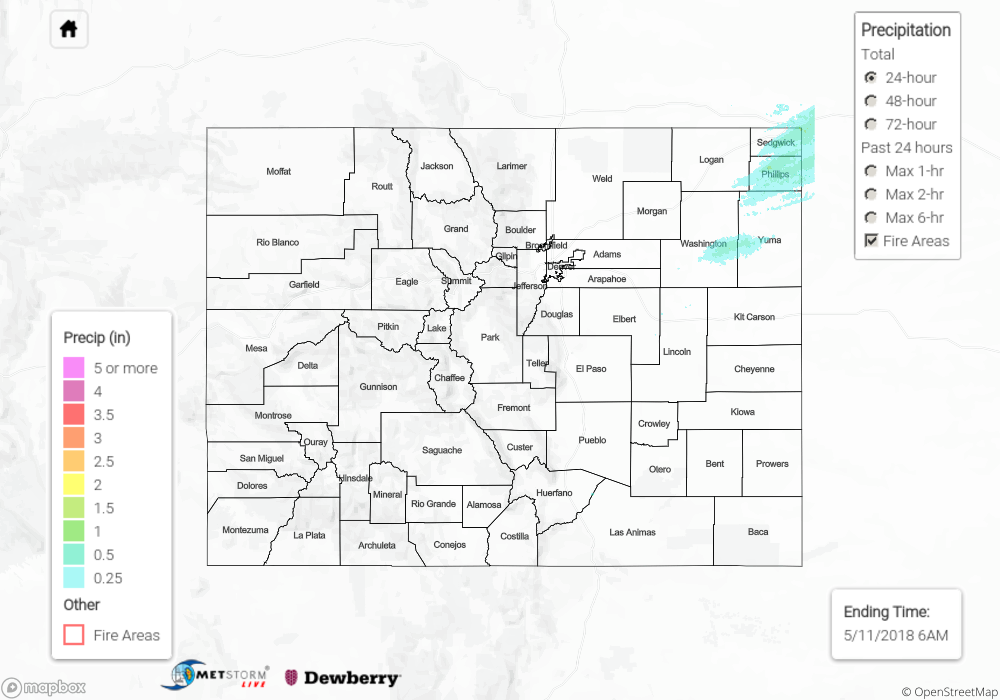
Dry and summer-like conditions could be found across much of the state, as the warming trend continued and pushed temperatures above Wednesday’s high temperatures. Offering a respite from the heat were isolated showers/thunderstorms, which dotted the state during the afternoon/evening hours, mainly along/north of I-70 where better moisture and upper-level support coincided. The strongest storms of the day rumbled across the Northeast Plains, where a few instances of severe hail were reported to the National Weather Service:

1.5 inch hail: North of Holyoke (Phillips County)
1.25 inch hail: 6 miles South of Julesburg (Sedgwick County)
1 inch hail: 6 miles SSE of Wages (Phillips County) and 1 mile SE of Holyoke (Phillips County)

A few light rain showers continued this morning across the higher terrain of the Northwest Slope, where surface moisture convergence, orographic effects, and upper-level support have kept the activity going. Overall, rainfall was light due and virga was plentiful as the near-surface moisture remained a bit on the low side, with only brief periods of moderate rainfall underneath the strong thunderstorms in northeast Colorado.

Flash flooding was not reported yesterday. For a look at precipitation estimates in your area, please see our State Precipitation Map below.

Click Here For Map Overview

The map below shows radar-estimated, rainfall gage-adjusted Quantitative Precipitation Estimates (QPE) across Colorado. The map is updated daily during the operational season (May 1 – Sep 30) by 11AM. The following six layers are currently available: 24-hour, 48-hour and 72-hour total precipitation, as well as maximum 1-hour, 2-hour and 6-hour precipitation over the past 24 hour period (to estimate where flash flooding may have occurred). The accumulation ending time is 6AM of the date shown in the bottom right corner. Also shown optionally are fire burn areas since 2012. The home button in the top left corner resets the map to the original zoom.

Note: We have identified a possible underestimation in QPE over the southwest part of the state. We are working to on this issue, and will provide an update as soon as possible.
SPM 05-10-2018: A Calm Day with a Stormy End on the Eastern Plains

Issue Date: Thursday, May 10th, 2018
Issue Time: 10:00 AM MDT

Summary:

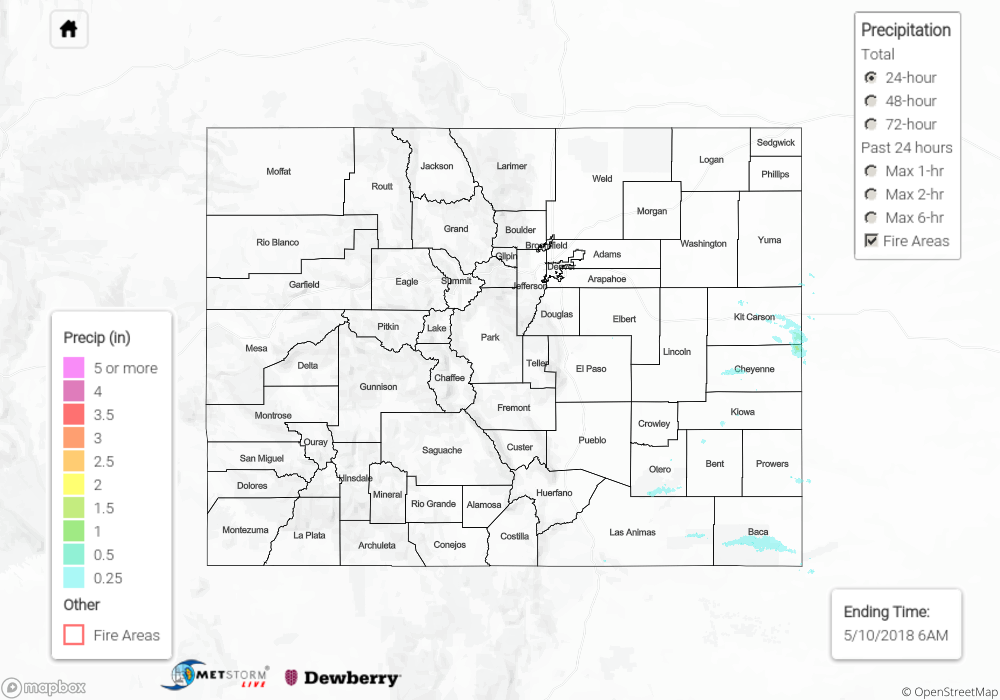
Wednesday in Colorado saw another day of mostly sunny, warm, and dry weather. Hopefully you were able to take advantage of these nice conditions, especially up in the mountains. By the afternoon, increasing cloud cover in the eastern half of the state led to the beginnings of thunderstorm activity from the Urban Corridor to the Northeast and Southeast Plains. For the most part, these thunderstorms produced the occasional high wind gust and plenty of virga draped across the early evening sky. Late in the afternoon, thunderstorms really began to pick up for the Southeast Plains. Rainfall left its mark from Kit Carson and south all the way to Las Animas and Baca counties, for the most part in less than an hour bursts of about 0.25 inches per hour, occasionally up to around 0.5 inches. One CoCoRaHS gauge in Cheyenne County recorded 0.45 inches over the course of the day Wednesday, and this was by far the most amount of rainfall recorded for any gauge in the area. Most other CoCoRaHS gauges in the Southeast Plains recorded between 0.05 and 0.25 inches. This can be seen as a testament to the sort of “popcorn” variety of storm seen over the late afternoon hours across eastern Colorado: many of them not fully developing into intense storms until they crossed the border into Kansas later on in the evening. In fact, it was these storms that brought blowing dust so intense that a couple of National Weather Service local storm reports in Kansas noted zero to a quarter mile visibility!

In all, no flash flooding was reported yesterday. For a look at precipitation estimates in your area, please see our State Precipitation Map below.

Click Here For Map Overview

The map below shows radar-estimated, rainfall gage-adjusted Quantitative Precipitation Estimates (QPE) across Colorado. The map is updated daily during the operational season (May 1 – Sep 30) by 11AM. The following six layers are currently available: 24-hour, 48-hour and 72-hour total precipitation, as well as maximum 1-hour, 2-hour and 6-hour precipitation over the past 24 hour period (to estimate where flash flooding may have occurred). The accumulation ending time is 6AM of the date shown in the bottom right corner. Also shown optionally are fire burn areas since 2012. The home button in the top left corner resets the map to the original zoom.
Note: We have identified a possible underestimation in QPE over the southwest part of the state. We are working to on this issue, and will provide an update as soon as possible.
SPM 05-09-2018: Bountiful Sunshine Dominated as High Pressure Took Over

Issue Date: Wednesday, May 9th, 2018
Issue Time: 9:30 AM MDT

Summary:

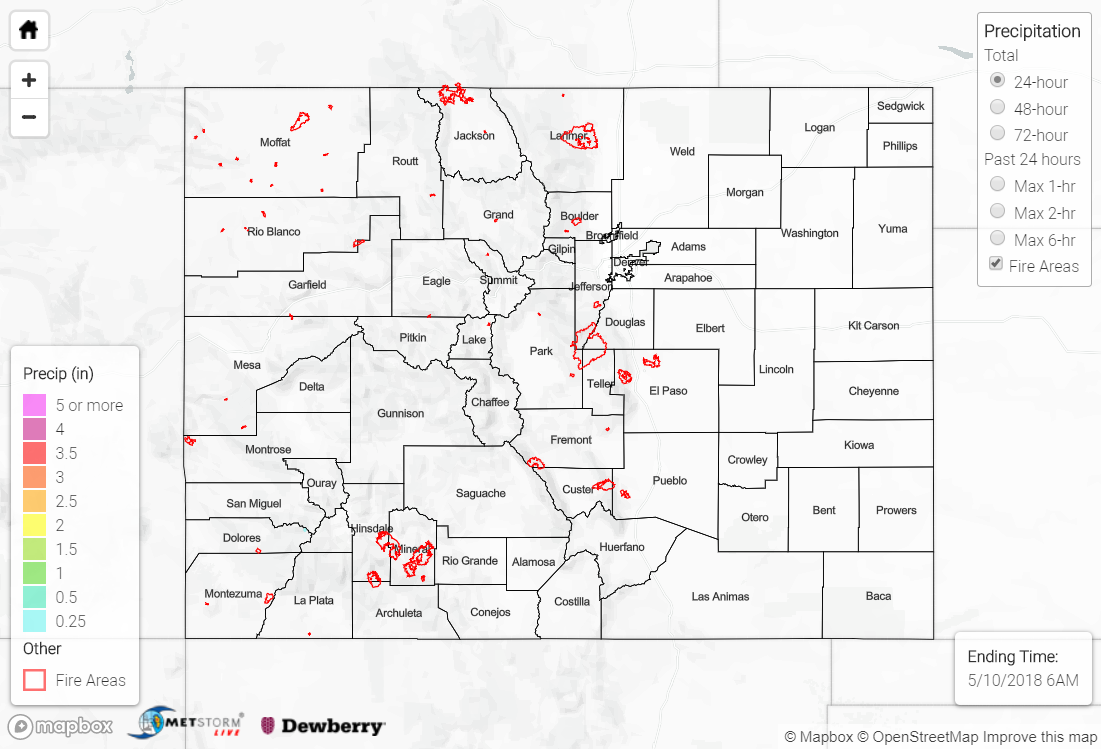
High pressure built overhead yesterday, ushering in dry air from the northwest and suppressing residual moisture from doing anything more than creating a few fair weather cumulus clouds. This left Colorado with plenty of sunshine and warm temperatures, so hopefully you were able to get outside and enjoy it, even if for only a few minutes. Overnight, a few high clouds made their way into far western Colorado thanks to the approach of a weak, upper-level disturbance and associated increase in moisture.

Flash flooding was not reported yesterday. For a look at precipitation estimates in your area, please see our State Precipitation Map below.

Click Here For Map Overview

The map below shows radar-estimated, rainfall gage-adjusted Quantitative Precipitation Estimates (QPE) across Colorado. The map is updated daily during the operational season (May 1 – Sep 30) by 11AM. The following six layers are currently available: 24-hour, 48-hour and 72-hour total precipitation, as well as maximum 1-hour, 2-hour and 6-hour precipitation over the past 24 hour period (to estimate where flash flooding may have occurred). The accumulation ending time is 6AM of the date shown in the bottom right corner. Also shown optionally are fire burn areas since 2012. The home button in the top left corner resets the map to the original zoom.
Note: We have identified a possible underestimation in QPE over the southwest part of the state. We are working to on this issue, and will provide an update as soon as possible.
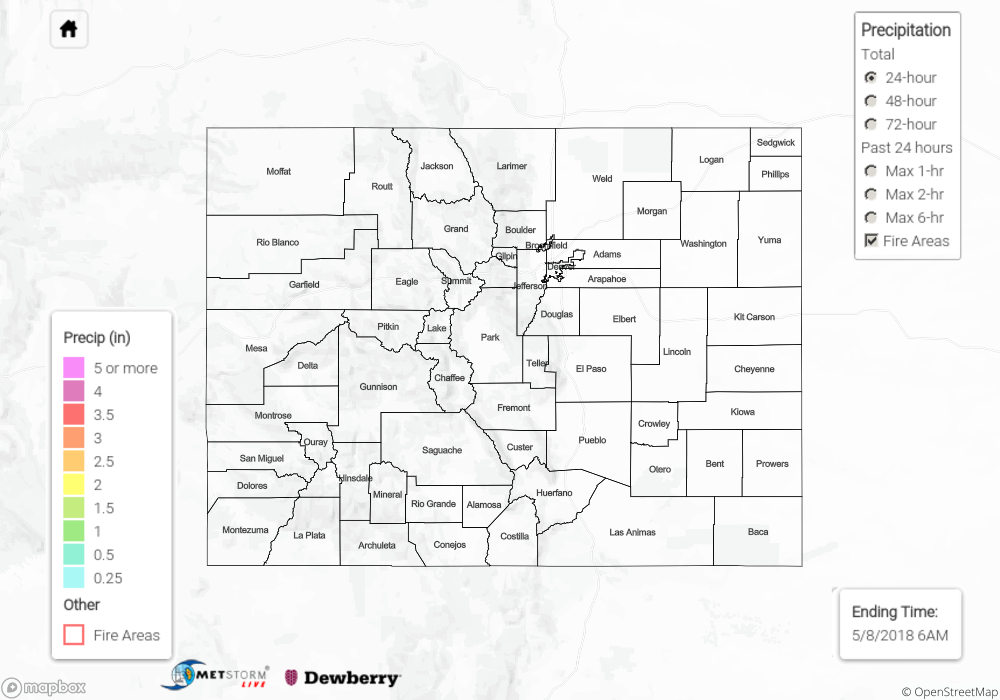
SPM 05-08-2018: Warm, Mostly Dry Monday despite Widespread Cloud Cover

Issue Date: Tuesday, May 8, 2018
Issue Time: 9:00AM MDT

Summary:

An upper trough moved through the state Monday afternoon through Tuesday morning. This kept widespread high and mid-level cloud cover throughout the day. Despite the cloud cover, drier air and westerly flow allowed high temperatures to reach the upper 70s and low 80s over the lower elevations. Temperatures over the southeast corner of the state even reached the mid 80s. The drier air limited rainfall totals over the mountains with various locations in the mountains reporting 0.1 inches. Higher dew points over the eastern plains were quick to mix out in the afternoon and all convection remained north of Colorado.

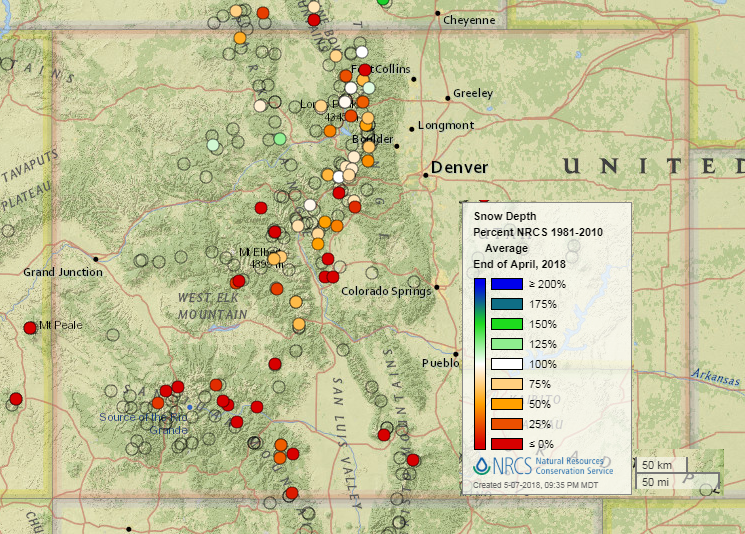
Below shows the average snow depth over Colorado for April at various SNOTEL sites when compared to average (1981-2010) from NRCS. The snowpack over the San Juan Mountains in southern Colorado is less than 25% of normal for this time of year. The high country to the north is fairing much better, but basins are still only at 85% of normal. Thankfully, reservoirs are at or above normal across the state, which will help lessen the impacts of the low snow depth. While it’s a bit early to tell what the fire season holds, rainfall this spring is imperative to help alleviate the developing drought over the southern portion of the state.

There was no flooding reported Monday. For an estimate of rainfall totals in your area, scroll down to the State Precipitation Map below.

Click Here For Map Overview

The map below shows radar-estimated, rainfall gage-adjusted Quantitative Precipitation Estimates (QPE) across Colorado. The map is updated daily during the operational season (May 1 – Sep 30) by 11AM. The following six layers are currently available: 24-hour, 48-hour and 72-hour total precipitation, as well as maximum 1-hour, 2-hour and 6-hour precipitation over the past 24 hour period (to estimate where flash flooding may have occurred). The accumulation ending time is 6AM of the date shown in the bottom right corner. Also shown optionally are fire burn areas since 2012. The home button in the top left corner resets the map to the original zoom.

Note: We have identified a possible underestimation in QPE over the southwest part of the state. We are working to on this issue, and will provide an update as soon as possible.