SPM 05-03-2018: Beneficial Spring Storm for Colorado

Issue Date: Thursday, May 3rd, 2018
Issue Time: 9:40 AM MDT

Summary:

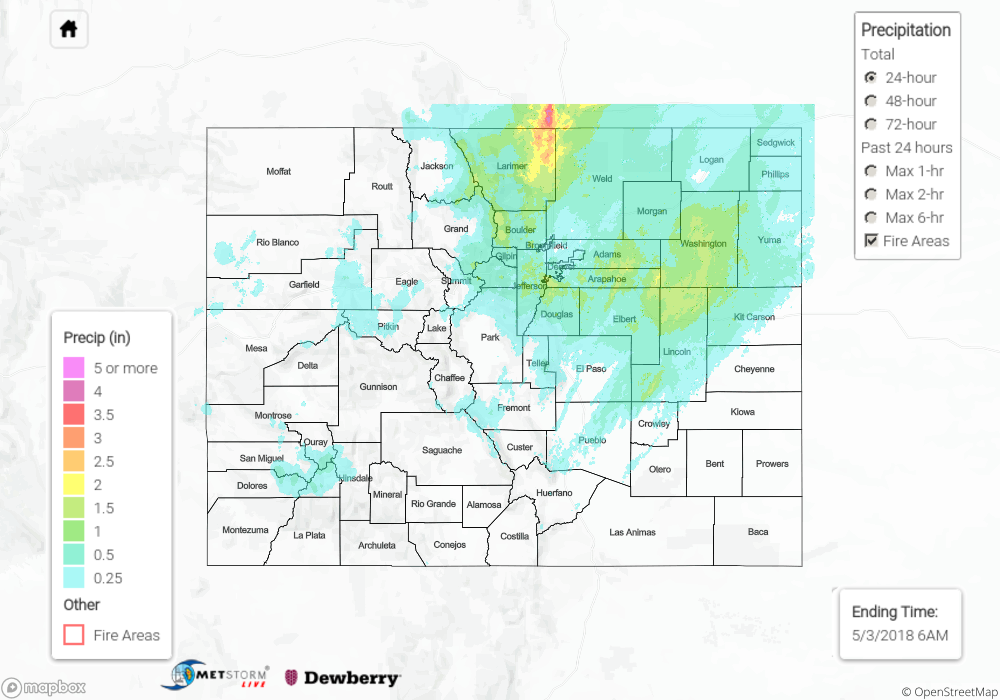
Scattered-to-widespread showers and thunderstorms impacted the state yesterday, and continue to do so this morning, thanks to the presence of an upper-level disturbance and plenty of moisture being pulled in from the Pacific. Most everywhere in the state got in on the action except for the far Southeast Plains, which hung on to the drier conditions and mustered only an isolated light shower or two. The high country received periods of heavy snow, generally above 9,000 feet, with 6-10 inches (or more) reported in some locations. As temperatures cooled overnight, snow levels dropped to as low as 7,000 feet this morning, bringing some accumulating snow to locations in the foothills and higher elevations of the Palmer Ridge.

For elevations below 9,000 feet (sans this morning’s transition to snow between 7,000-9,000 feet), rainfall was generally light-to-moderate, with pockets of heavier rain mixed in across the Northeast Plains, Palmer Ridge, and Urban Corridor regions. Small hail accompanied a few thunderstorms, with the largest hail of the day (0.88 inches in diameter) reported 6 miles W of Punkin Center (Lincoln County).

Flash flooding was not reported yesterday. For a look at precipitation estimates in your area, please see our State Precipitation Map below.

Click Here For Map Overview

The map below shows radar-estimated, rainfall gage-adjusted Quantitative Precipitation Estimates (QPE) across Colorado. The map is updated daily during the operational season (May 1 – Sep 30) by 11AM. The following six layers are currently available: 24-hour, 48-hour and 72-hour total precipitation, as well as maximum 1-hour, 2-hour and 6-hour precipitation over the past 24 hour period (to estimate where flash flooding may have occurred). The accumulation ending time is 6AM of the date shown in the bottom right corner. Also shown optionally are fire burn areas since 2012. The home button in the top left corner resets the map to the original zoom.

Note: We have identified a possible underestimation in QPE over the southwest part of the state. We are working to on this issue, and will provide an update as soon as possible.
SPM 05-02-2018: Scattered Showers and Thunderstorms Dotted the State

Issue Date: Wednesday, May 2nd, 2018
Issue Time: 7:00 AM MDT

Summary:

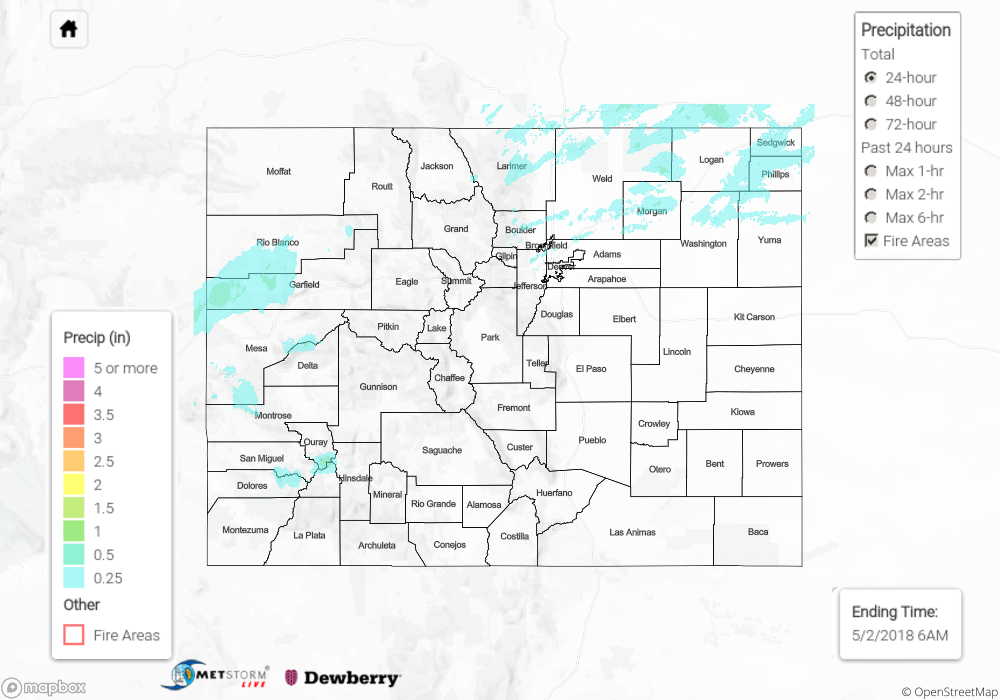
An upper-level disturbance rotating into the region helped to support widely scattered showers and thunderstorms during the afternoon/evening hours yesterday, with the strongest storms tracking over the Front Range, Urban Corridor, and Northeast Plains. The stronger storms in these regions produced hail, strong winds, and periods of moderate rainfall. Severe storm reports from these storms includes:

1.5 inch hail: 3 miles NNE of Yuma (Yuma County)
1.25 inch hail: 2 miles S of Platner (Washington County)
1 inch hail: Yuma (Yuma County), Firestone (Weld County), and SW Akron (Washington County)

A weak surface cool front that began the day over the Northeast Plains drifted south during the evening hours, kicking off a few showers/weak thunderstorms over the Palmer Divide, resulting in mainly light rain and gusty winds.

As the evening turned to nighttime and early morning, the activity over these regions slowly came to an end and shower activity over the high country increased in coverage. Owing to a lack of good low-level moisture, these showers produced light rain and gusty winds, with plenty of virga to go around.

Flash flooding was not reported yesterday. For a look at precipitation estimates in your area, please see our State Precipitation Map below.

Click Here For Map Overview

The map below shows radar-estimated, rainfall gage-adjusted Quantitative Precipitation Estimates (QPE) across Colorado. The map is updated daily during the operational season (May 1 – Sep 30) by 11AM. The following six layers are currently available: 24-hour, 48-hour and 72-hour total precipitation, as well as maximum 1-hour, 2-hour and 6-hour precipitation over the past 24 hour period (to estimate where flash flooding may have occurred). The accumulation ending time is 6AM of the date shown in the bottom right corner. Also shown optionally are fire burn areas since 2012. The home button in the top left corner resets the map to the original zoom.

Note: We have identified a possible underestimation in QPE over the southwest part of the state. We are working to on this issue, and will provide an update as soon as possible.
SPM 05-01-2018: Welcome Back to the Flood Threat Bulletin for the 2018 Season

Issue Date: Tuesday, May 1st, 2018
Issue Time: 9:15 AM MDT

Summary:

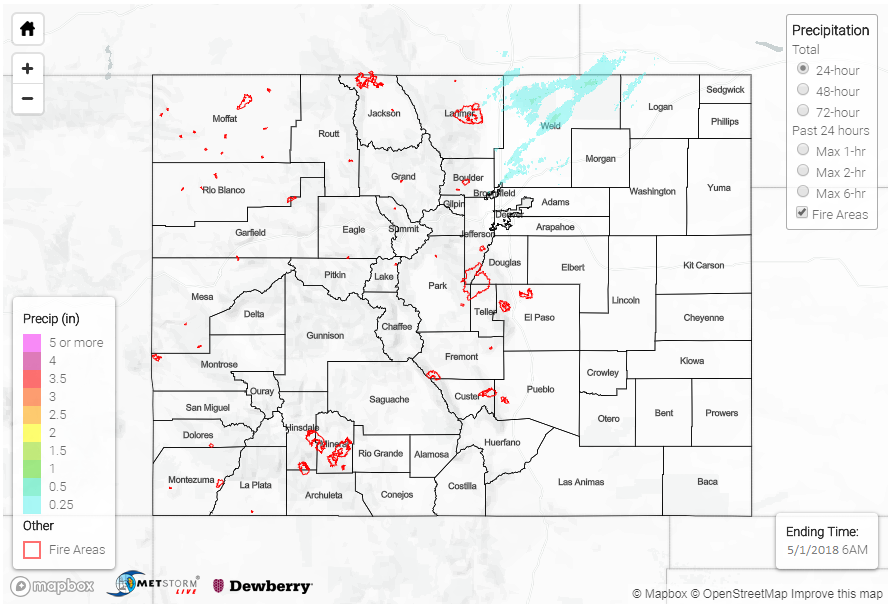
Mother Nature must have gotten the word that the 2018 FTB was about to kick off, as she welcomed the new season with scattered showers across portions of the western slope and scattered showers/thunderstorms across Northeast Colorado. Across the western slope, showers were garden variety, moving fairly slowly with low rain rates. Showers continue this morning across portions of the Grand Valley, Northwest Slope, and Southwest Slope regions, though this activity is resulting in mainly virga with little precipitation reaching the surface.

It was a slightly different story across Northeast Colorado, where better instability and moisture resided, resulting in scattered showers/thunderstorms that impacted portions of the Front Range, Urban Corridor, and Northeast Plains. This activity mainly occurred during the afternoon and evening hours, with nearly all activity dissipating by midnight. While moisture was good enough to produce thunderstorms, it was still too low to result in heavy rain, with gusty winds and periods of light-to-moderate rainfall as the main impacts. A few light showers continued into the early morning hours, resulting in little additional rainfall. One lonely severe storm report was logged during yesterday’s activity: 1.25 inch diameter hail was reported 1 mile SSW of Fort Lupton (Weld County). Weld County was also the rainfall winner yesterday, with one CoCoRaHS report of 0.45 inches near Briggsdale. Most locations, though, received less than 0.1 inches of rainfall.

Flash flooding was not reported yesterday. For a look at precipitation estimates in your area, please see our State Precipitation Map below.

Click Here For Map Overview

The map below shows radar-estimated, rainfall gage-adjusted Quantitative Precipitation Estimates (QPE) across Colorado. The map is updated daily during the operational season (May 1 – Sep 30) by 11AM. The following six layers are currently available: 24-hour, 48-hour and 72-hour total precipitation, as well as maximum 1-hour, 2-hour and 6-hour precipitation over the past 24 hour period (to estimate where flash flooding may have occurred). The accumulation ending time is 6AM of the date shown in the bottom right corner. Also shown optionally are fire burn areas since 2012. The home button in the top left corner resets the map to the original zoom.

Note: We have identified a possible underestimation in QPE over the southwest part of the state. We are working to on this issue, and will provide an update as soon as possible.
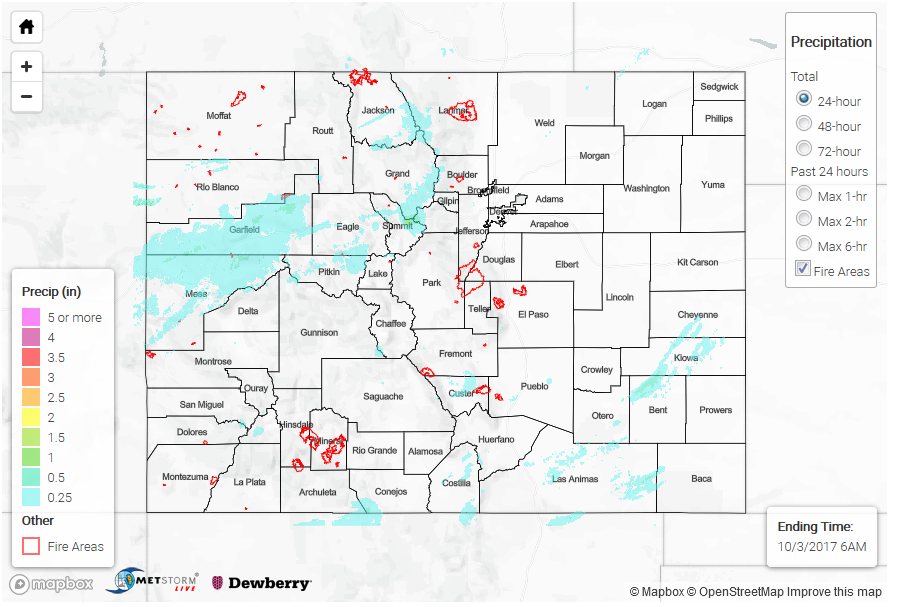
SPM 09-30-2017: Rain And High Elevation Snow Mainly Across Western Colorado

Issue Date: Saturday, September 30, 2017
Issue Time: 10:45AM MDT

Summary:

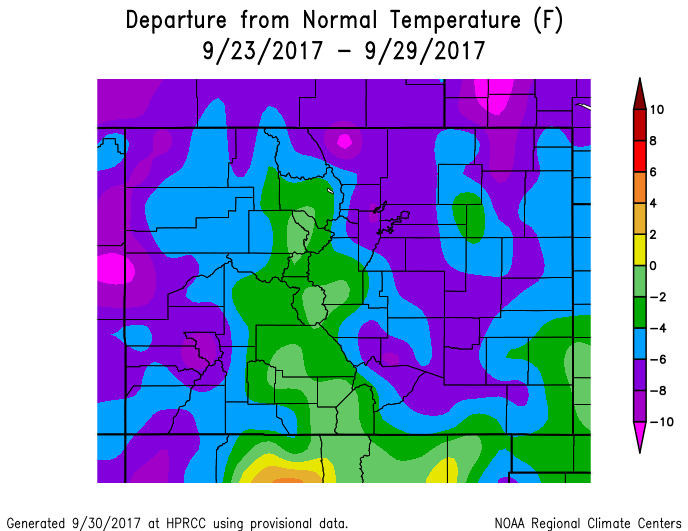
Unsettled weather continued for Colorado as a large-scale trough continued to envelop the western United States. Over the last week, temperatures have ranged anywhere from 2 to 10F below normal across the state (see below), one indicator of frequent cloud cover that has limited heating.

Despite the active weather, rainfall rates continued to be limited due to weak instability and limited boundary layer moisture. Isolated twenty four rainfall amounts up to 1 inch occurred over the higher terrain of southwestern Colorado on Friday. However, hourly rain rates were limited to less than about 0.4 inches. Despite the limited instability, a few reports of small hail were reported along the counties by the New Mexico border. This was probably more of a testament to low freezing levels than atmospheric instability.

Flooding was not reported on Saturday. For rainfall estimates in your area, check out our State Precipitation Map below.

Click Here For Map Overview

The map below shows radar-estimated, rainfall gage-adjusted Quantitative Precipitation Estimates (QPE) across Colorado. The map is updated daily during the operational season (May 1 – Sep 30) by 11AM. The following six layers are currently available: 24-hour, 48-hour and 72-hour total precipitation, as well as maximum 1-hour, 2-hour and 6-hour precipitation over the past 24 hour period (to estimate where flash flooding may have occurred). The accumulation ending time is 6AM of the date shown in the bottom right corner. Also shown optionally are fire burn areas since 2012. The home button in the top left corner resets the map to the original zoom.

Note: We have identified a possible underestimation in QPE over the southwest part of the state. We are working to on this issue, and will provide an update as soon as possible.