SPM 06-28-2018: Hot Temperatures and a Few High-BasedThunderstorms

Issue Date: Thursday, June 28th, 2018
Issue Time: 9:30 AM MDT

Summary:

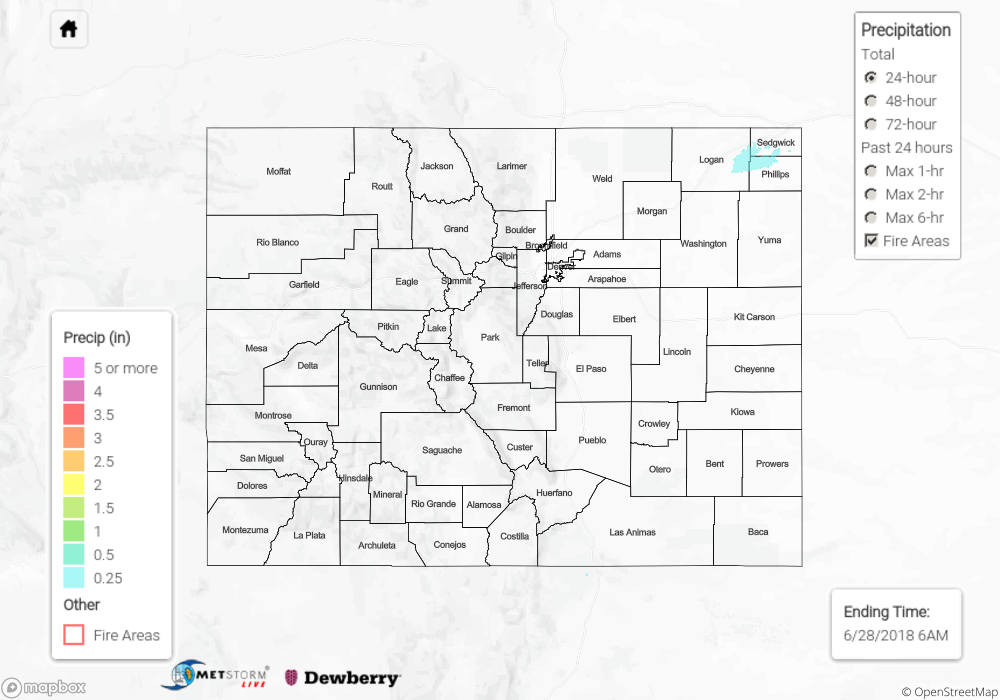
The mercury climbed higher over the previous day as the strong high pressure ridge remained overhead. High temperatures were in the upper-90s and low-100s across the eastern plains, with upper-80s in the lower mountain valleys, and upper-90s in the lower valleys near the CO/UT border. A weak ripple in the southwest flow aloft, combined with the strong daytime heating, led to the development of isolated high-based showers/thunderstorms over central and eastern Colorado. Extremely dry air below cloud bases evaporated nearly all rainfall before it could reach the ground, resulting in strong winds gusts and very little rainfall at the surface. In fact, high-based storms near the Denver metro area produced strong wind gusts: a 58 MPH wind gust was reported at Denver International Airport at 4:40 PM, and a 61 MPH wind gust was reported at the NCAR Mesa Lab in Boulder at 6:10 PM. High-based shower/thunderstorm activity diminished from west to east, and the last of the showers ended over the Northeast Plains between 1 and 3 AM.

No flash flooding occurred yesterday. For a look at precipitation estimates in your area, please see our State Precipitation Map below.

Click Here For Map Overview

The map below shows radar-estimated, rainfall gage-adjusted Quantitative Precipitation Estimates (QPE) across Colorado. The map is updated daily during the operational season (May 1 – Sep 30) by 11AM. The following six layers are currently available: 24-hour, 48-hour and 72-hour total precipitation, as well as maximum 1-hour, 2-hour and 6-hour precipitation over the past 24 hour period (to estimate where flash flooding may have occurred). The 24-hour, 48-hour and 72-hour total precipitation contain bias corrections that are not disaggregated into the hourly estimates, so there will likely be some differences. The accumulation ending time is 6AM of the date shown in the bottom right corner. Also shown optionally are fire burn areas (post 2012), which are updated throughout the season to include new burn areas. The home button in the top left corner resets the map to the original zoom.
SPM 06-27-2018: Abundant Blue Skies and Hot Temperatures

Issue Date: Wednesday, June 27th, 2018
Issue Time: 9:30 AM MDT

Summary:

Strong high Pressure settled over the state yesterday, leading to a day dominated by blue skies and abundant sunshine. Temperatures warmed quickly under the summer sun, with highs in the 90s across the plains, 80s in lower mountain valleys, and exceeding triple digits across portions of the Southeast Plains. There wasn’t anything Mother Nature could do to overcome the high pressure; only a few high clouds over/near the northern Front Range and Northern Mountains is all she could muster.

No flash flooding occurred yesterday. For a look at precipitation estimates in your area, please see our State Precipitation Map below.

Click Here For Map Overview

The map below shows radar-estimated, rainfall gage-adjusted Quantitative Precipitation Estimates (QPE) across Colorado. The map is updated daily during the operational season (May 1 – Sep 30) by 11AM. The following six layers are currently available: 24-hour, 48-hour and 72-hour total precipitation, as well as maximum 1-hour, 2-hour and 6-hour precipitation over the past 24 hour period (to estimate where flash flooding may have occurred). The 24-hour, 48-hour and 72-hour total precipitation contain bias corrections that are not disaggregated into the hourly estimates, so there will likely be some differences. The accumulation ending time is 6AM of the date shown in the bottom right corner. Also shown optionally are fire burn areas (post 2012), which are updated throughout the season to include new burn areas. The home button in the top left corner resets the map to the original zoom.

SPM 06-26-2018: Quiet Day with Seasonal High Temperatures

Issue Date: Tuesday, June 26, 2018
Issue Time: 09:35AM MDT

Summary:

Quiet day across Colorado after an active Sunday afternoon. The trough slowly progressed eastward throughout the day, and in its place general subsidence took over. There were a few cumulus over the mountains, but other than that a beautiful day across the state with more seasonable high temperatures. Over the northeast corner, some linger showers continued through the early afternoon on the backside of the low. More clouds than rain were produced with precipitation totals under 0.1 inches. The 416 Fire continues to burn north of Durango. It grew 580 acres on Sunday due to the gusty winds associated with the passing trough. The fire is 37% contained and has burned nearly 35,000 acres. Hot temperatures through the end of this week are expected to continue to help the fire strengthen. Critical fire conditions will be monitored daily in the FTB.

To see how much precipitation fell in your area over the last 72-hours, scroll down to the State Precipitation Map below.

Click Here For Map Overview

The map below shows radar-estimated, rainfall gage-adjusted Quantitative Precipitation Estimates (QPE) across Colorado. The map is updated daily during the operational season (May 1 – Sep 30) by 11AM. The following six layers are currently available: 24-hour, 48-hour and 72-hour total precipitation, as well as maximum 1-hour, 2-hour and 6-hour precipitation over the past 24 hour period (to estimate where flash flooding may have occurred). The 24-hour, 48-hour and 72-hour total precipitation contain bias corrections that are not disaggregated into the hourly estimates, so there will likely be some differences. The accumulation ending time is 6AM of the date shown in the bottom right corner. Also shown optionally are fire burn areas (post 2012), which are updated throughout the season to include new burn areas. The home button in the top left corner resets the map to the original zoom.
SPM 06-25-2018: End of Weekend Cool Down comes with Hail and Widespread Rain

Issue Date: Monday, June 25, 2018
Issue Time: 09:05AM MDT

Summary:

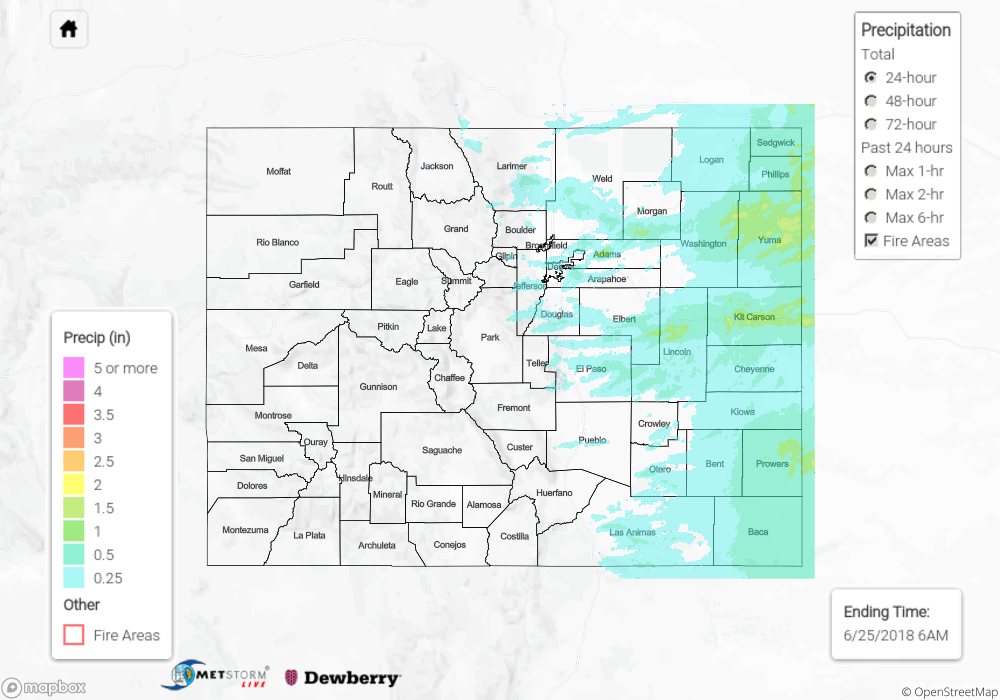
An early morning frontal passage helped keep high temperatures much more comfortable on Sunday. Behind the front, upslope flow helped kick off a round of early afternoon showers and thunderstorms across the Urban Corridor and Northern Mountains/Front Range. Quick, heavy rainfall accompanied the storms and a funnel was reported near Steamboat Springs. With cooler temperatures and extra lift from the trough over WY, there were numerous reports of snow-like, accumulating hail across the Front Range. The hail was small over the Urban Corridor, but it caused some flooding issues as it clogged gutters and pooled water on the roadways. Gages in the area jumped 2-3 feet but were well below the flooding stage. Total rainfall was estimated to be up to 1 inch with the highest UDFCD ALERT gage in Denver recording 0.63 inches (Rocky Mountain Arsenal).

As the front moved south, more showers and thunderstorms were triggered along the higher terrains. As the storms moved east into better moisture, shear and CAPE, they began producing larger hail and gusty winds. In eastern El Paso County, hail up to 2 inches in diameter was reported. Max 1-hour rain rates around 1 inch were estimated by radar. Further east over the plains, rain rates were estimated a bit over 1.5 inches/hour with 24-hour totals just under 2 inches. A CoCoRaHS station in Yuma County recorded 1.75 inches on Sunday. A wind gust of 66 mph was also reported at the Burlington Airport and a gust of 70 mph was recorded at the Lamar Airport. The eastward moving convection made its way out of the state by 11:30 PM, but a few showers lingered over the eastern plains through this morning.

To see how much precipitation fell in your neighborhood on Sunday, scroll down to the State Precipitation Map below.

Click Here For Map Overview

The map below shows radar-estimated, rainfall gage-adjusted Quantitative Precipitation Estimates (QPE) across Colorado. The map is updated daily during the operational season (May 1 – Sep 30) by 11AM. The following six layers are currently available: 24-hour, 48-hour and 72-hour total precipitation, as well as maximum 1-hour, 2-hour and 6-hour precipitation over the past 24 hour period (to estimate where flash flooding may have occurred). The 24-hour, 48-hour and 72-hour total precipitation contain bias corrections that are not disaggregated into the hourly estimates, so there will likely be some differences. The accumulation ending time is 6AM of the date shown in the bottom right corner. Also shown optionally are fire burn areas (post 2012), which are updated throughout the season to include new burn areas. The home button in the top left corner resets the map to the original zoom.