Issue Date: Saturday, July 16, 2016
Issue Time: 9:30AM MDT
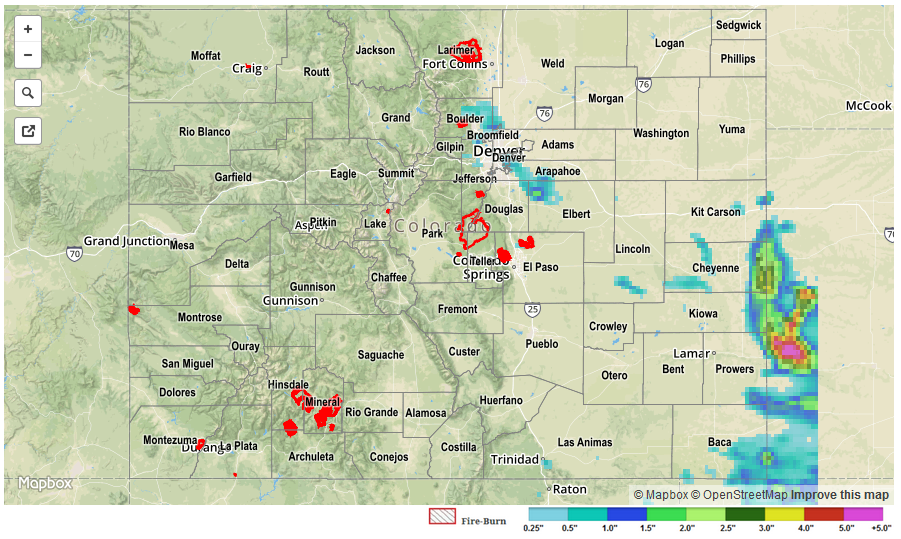
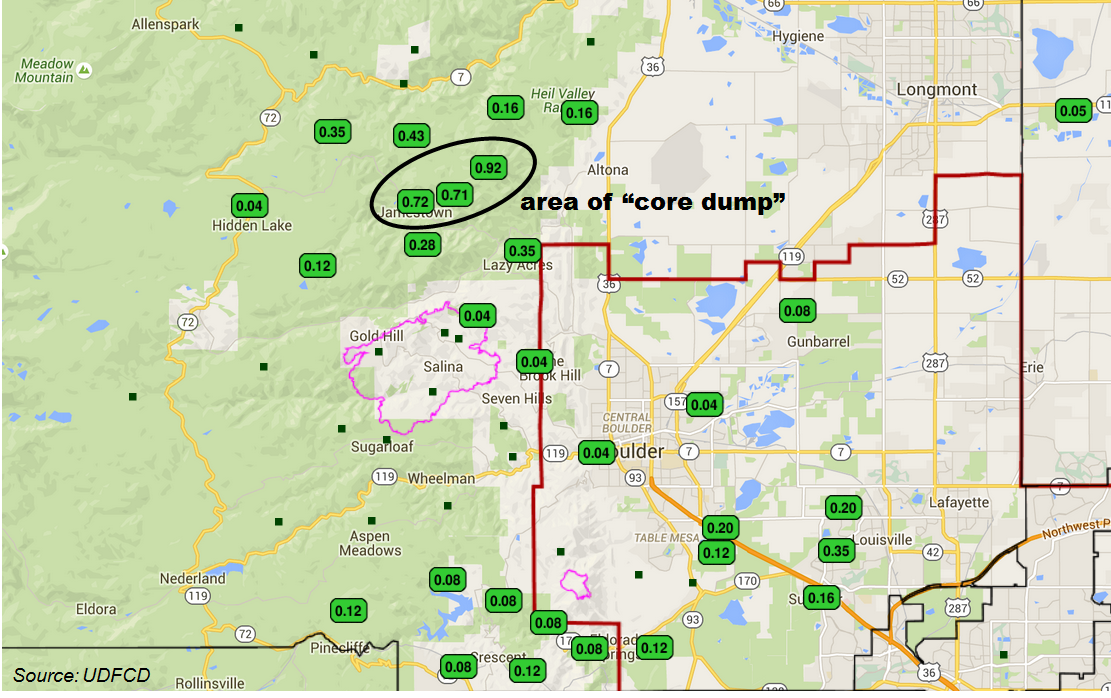
The dog days of summer (a reference to the annual emergence of the Canis Major constellation) are upon us, and that means hot conditions that are capable of producing thunderstorms even with otherwise marginal atmospheric forcing. We saw an example of this on Friday as two pockets of scattered thunderstorms developed in the late afternoon. The first area was in the Front Range and Urban Corridor, where Mother Nature seized a narrow window of opportunity right before the passage of a stabilizing cool front to produce a small cluster of storms that moved across the Denver metro area. One particularly strong cell produced a 30-minute rain rate near 0.75 inches during its “core dump” phase just northeast of Jamestown. This occurs when the storm’s feed of unstable air is rapidly cut-off leading to a quick vertical drop of all the suspended water mass that has recently entered the updraft. We can see this in the 24-hour rainfall map below taken from the Urban Drainage and Flood Control District’s gage totals. Note that several gages show values much higher than surrounding sites, indicating where the storm abruptly collapsed. In addition to the heavy rainfall, 2 inch hail was observed near Centennial.
The second area was in the Southeast Plains right along the KS border, south of I-70, where very impressive storms raced southward with initial nudging from a southward moving cool front. These storms produced the full gamut of severe weather: hail up to 2.75 inches, straight-line winds over 60 mph, several tornadoes and of special relevance to us, heavy rainfall. Despite the impressive southward storm motions of 45 mph, one hour rainfall rates between 1.5 – 2.0 inches occurred in far eastern Cheyenne and Kiowa counties.
Across the western part of the state, dry and hot conditions continued to support an elevated wildfire risk. There are now four active wildfires classified under the “large incident” category. Please keep informed through local NWS updates as well as the USDA’s Forest Service wildfire page.
There were no official flooding reports yesterday. For specific rainfall estimates in your area, check out our Storm Total Precipitation map below.