Issue Date: 8/6/2015
Issue Time: 9:05 AM
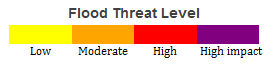
NO FLOOD THREAT IS FORECAST.
Mother Nature has decided to turn off the faucet and turn on the heat for today, resulting in a day full of sunshine and basically devoid of precipitation. The upper-level ridge will be centered over New Mexico today, leaving a subsident air mass over Colorado and continue the drying trend seen over the last few days. There just simply will not be support for thunderstorms today or tonight. An isolated shower or two over the higher terrain will be possible, but the chances are less than 10% and will produce very little rainfall at the surface, if any. High temperatures today will be a few degrees above average for this date.
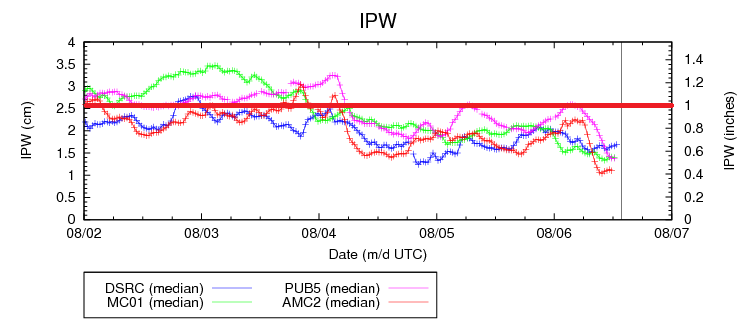
The next monsoonal surge will arrive tomorrow as the upper-level ridge slides to the east in response to an approaching upper-level trough. Tune into the Flood Threat Outlook this afternoon for more information on this storm, and what conditions the next 15 days hold, overall. And, as always, check back in with tomorrow’s Flood Threat Bulletin.
Today’s Flood Threat Map
For more information on today’s flood threat, see the map below (hover over threat areas for more details). For Zone-Specific forecasts, jump below the map.
Zone-Specific Forecasts
Urban Corridor, Northeast Plains, Raton Ridge, Palmer Ridge, and Southeast Plains:
Mostly sunny and hot, with high temperatures upper-80s/low-90s along the Urban Corridor and across the Palmer/Raton Ridge, ranging into the mid-/upper-90s across the plains regions. Locations in the Arkansas River Valley near the CO/KS border will flirt with 100 degrees.
Northern Mountains, Front Range, Central Mountains, Southeast Mountains, San Juan Mountains, Northwest Slope, Southwest Slope, San Luis Valley, and Grand Valley:
Mostly sunny and hot, with high temperatures a few degrees above average for this date. An isolated shower or two over the higher terrain cannot be ruled out this afternoon, but probabilities are less than 10%. Little to no rainfall at the surface will result, and the only potential impact will be weak, cooler wind gusts.

